

About Contact Submit Article or Event

Escalating to rare paradigms of art education


That a quest to seeking knowledge lends credibility to any pursuit cannot be better emphasized but the course of such a journey, largely depends on and derives its worth in the seeker’s risk taking and challenge facing abilities. Especially amongst biases like the sciences tagged main stream and arts lurking in the background even at higher levels of education, an art affair is definitely upstream task. Gathering on this background is an ingenious discussion session on changing the structures of institutionalized art education towards better sustainability.
Creditably facilitating this is Dr. Vasanth Kiran, Head of Department of Performing Arts, who though sitting on a precarious position, is striving at will to make the best resources in dance available to, at least every seeker at his University. “I have been a Business faculty before coming into this Department. I was completely aware of UGC’s requirement of credit hours. So one of the foremost incorporation here was to give ‘performance’ and ‘field trip’ their due credit hours. Performing is an experience that adds on to one’s academic faring. On the flip side, every time a student is on the stage, something from the class has changed the way he/she performs, which becomes a reality check. Thus 25% of attendance is acceptable if a student has gone for a performance. With this, the overall annual structure for credit hours under the UGC is well maintained whilst catering to specific requirement of an art where performing is focal!”.


Alliance travels to Chennai
Between getting the right access to resources and managing and distributing them, it is the latter that needs greater precedence. “I ensured that our regular full time faculty comprise of young, dynamic, throwing-challenges-on-them, ready to travel members and all stalwarts and senior gurus are visiting faculty. That way the students have somebody they can easily approach, share inhibitions and clarify doubts on a daily basis, while also receiving forthright critical feedback.” Given such discerning thinking, the core syllabus of the two year Masters in performing arts has been carefully designed to stretch boundaries in art approach, create thinking dancers and most peculiarly allow for other professional employments. Says Abhinaya Rohan, a working Chartered Accountant turned dance student “I have always liked numbers. But my inclination to connect the numbers in accounts and numbers in the tala system of dance, came about after my acquaintance to Dr. Vasanth! I had a sound training in dance at a young age, studied CA and worked in Goldman Sachs and now it was time to make my choice, take the plunge. I am a manager at a startup working from 8 AM to 1 PM and then come to classes at the University. I now draw parallels – bring the commerce professional discipline here and take hard work that dance has taught me to my CA work. Guess there is a greater feeling of contributing to the economy!” To which Vasanth adds “This precisely was one of our targeted course plan while instituting the program. The first semester students take classes in the morning and second semester students in the afternoon. Most of them are employed accordingly in shifts and for those who are not, we tie them up with a school as dance teacher and so at the end of the MA program they accrue a two-year work experience too! Radically the idea for such design comes from my corporate culture where case studies and real life experiences of firms are infused into the study course. Thus be it madam Usha Dattar partaking her experience in Kala Mandalam or Shama Bhate ji giving nuances of tala system in Kathak, or even Dharshana Jhaveri ji illustrating how extremely important it is to study text before applying, theories from such sessions find application in any stream; Bharatanatyam or Kuchipudi. Similarly, all choreographies here are done in the class, so the students are a part of the process. In fact, the students most often contribute the content or at other times, the same jathi is being done by each of them in their own version right here in the class.”


Students at Alliance University

In this effort of creating a broader schema for assimilation of knowledge, Dr. Vasanth and his team of faculty and students are clear to stay away from restricting boundaries. “Talking of ‘bani’ in this Department is almost banned. I was at a conference recently when a speaker called for attention by claiming Natyasastra to be a perspective alone. True. The treatise talks about ‘vrittis’ which boils down to meaning school and this later became ‘bani’ calling for very narrow segregations in a vast form like dance. What is important is to only attempt to imbibe what the treatise offers, which itself is an impossible task, and hence when different bodies and minds attempt this, they are making and giving rise to different perceptions and so be it. Compartmentalizing is doing no gain. Finally, all of this is being translated onto stage performance and hence it also transforms into a perception of what is beautiful and aesthetic.
On the same lines, it is impertinent to understand and work with a whole amount of underpinnings that dance comes with – of time, space, balance, physical anatomy. To put it in a nutshell, education here aims to be holistic. We are not here to churn performers who can dance the hell out of every sabha, rather we groom their niche areas and channelize them professionally.”
Clearly the University is not hell bent on crying aloud of bringing about the much talked about ‘Change’, rather they are dedicated to visualize change in the broad sense of the term, accept and apprehend as much of it as possible. “The meaning of one generation until a few years back was about 20 years, clearly now, one generation is only 5 years! Because every five years, we are looking at an absolute change in each of the chaturvida abhinaya for example. Aharya has changed tremendously, vaachika is evolving, sometimes in a good way, aangika is approached differently and saatvika poor thing has metamorphed in to many meanings! This journey has always oscillated between probably giving significance to the insignificant or vice versa or sometimes even being ignorant. Where science and technology define growth in as far terms you move ahead and economics places it in growing GDPs, art sees it in the reverse. In art, the more you go back in time and connect to your roots, the more knowledgeable you become. And amidst all this tradition, transition and transformation, let me be honest, as a marketing guy, we need to know that we have to make a product that a customer wants. So if you are a dancer, happy practicing behind closed doors, then you can do your will, but if you are a performer on the proscenium or like in the University we want to make professionals out of each student, you need to accept change, be versatile, place your audience in priority and have clarity in moving ahead.”


A workshop by Geeta Chandran

So then, I discretely noticed the infusion of management principles to suit the dance framework, in a way that could not only complement a study, research and performance structure but also aid in its growth. “In today’s world we need to be aware what and to whom we are catering to, going back on the point of keeping an audience in priority that I mentioned. We recently performed Kuchipudi dance drama in Kerala and decided to do the vaachika in Malayalam. Kerala audience, given their proximity to lengthy dance dramas would sit through anyway, but this effort revoked a keener interest. Now, this may be branded as breaking away from tradition, but according to me one has to know tradition to even break away from it. So I am good this way. All of these students and faculty who rendered in Malayalam knew the entire script in Telugu as originally. Well as a matter of fact this overview has been there since Vempati master. He did away with dialogues in all his choreographies and it was only up to the music ensemble to do the vaachika. It is important to create your own space, if you are confident you can deliver it with beauty and aesthetic, you should move on rather than be dogged by branding. Despite Infosys, Wipro etc doing so well, there is still space in the market for a so called ‘Infotech software’ and they all exist and make money. So it is about creating space as an artist. If you feel you don’t have space as a performer, create one for yourself as an organizer or a researcher or a writer, the options are endless.”
On this note, I turn to the students of their approximation of areas of interest, their niche. For Prateeksha Kashi, fusing the conceptual fabric of her Management degree to the idea of dance becomes her strength. “I come from a computer science background and am a people’s person. So what I was looking for before switching to dancing professionally, was to cash in on the idea of management in dance. So at Alliance with Vasanth sir, having PhD’s in both these areas, I felt it was an exploring ground for me. I find the balance of theory and practice coming off beautifully here, something which I yearned to achieve. I never related to the fact that performance was by itself and research was in a different space. The flexibility given to me as a student is only helping me push the bar higher, as he rightly said, I am now more informed as a performer, I know the context of my performance.”


With Uma Rele and Vaidehi Rele
Karpagam Venkat Raman comes from traditional one-on-one tutelage under Smt. Lakshmi Rajamani for about 30 years. What she brings to the table is such experience and takes away eclectic training methods that she gets exposed to here at the University. “Coming from a very closed personalized training set up to being suddenly exposed to so much of activity created some disturbance but I was motivated to hold on to my training and my roots, while also learning from so many stalwarts here. That helped regain confidence and I transferred most of what I learnt to teaching my students. It has made a big difference. Overall dance and knowledge of it has reigned”.
Shishira Praveen hails from Kerala, and it is default understood of grounded training in at least four dance forms. “After having the opportunity to learn from Kalamandalam Leelamani teacher and Kshemavathy teacher, I drifted to Engineering and did not dance for 10 years. All of a sudden I found myself here and within the first few days, decided to quit again. My body gave up and I lost courage. If I have come back, it is because of the demanding curriculum that keeps one going along with a lot of mentoring from Vasanth sir.”
For Abhinaya, it is a lurking big question to actually identify what she is good at. Add to this is the plethora of options and vast canvas that art as a subject has opened up to her at the University. “At least in CA I knew what I did not want – whether I wanted audit or not etc, whereas here picking a subset out of the universe is seeming a huge task, I am working on that. But one thing I am sure about is that after this kind of backing, I can be rest assured I will do great in whatever I choose to. Well, sometimes it can work the other way too as one gets confused with so many options, but training in the immediacy of tradition gives the realization of knowing our limits.”


Master class in progress
The University has come a long way from its initiation, humbly enough and in the most genuine manner to stand up to a threshold where practitioners, connoisseurs and veterans most willingly offer to take workshops and master classes and develop an association. The names include Vasundhara Doreswamy, Geeta Chandran, Kanak Rele,Nandini Ramani, Lakshmi Vishwanathan, Vempati Ravi Shankar, Manju Bharggavee among many others.“Alliance does not have ‘anti-Alliance’ people. We are not against anybody in Bangalore. We attend every program in town. We are very happily having a strong network with every dancer / dance teacher in Bangalore and for that matter India. Most senior dancers and gurus have been invited and have expressed extreme happiness to be sharing a relationship. Dancers in Bangalore are welcome to attend these workshops or meet the gurus or interview them. The greatest benefit for the students is to talk to these great people with 40-50 years of experience, of dance that is also intact! So it is a conscious effort to bring them here, only so students can just sit and listen to untold stories and journey of dance, to decide if they even want to trend the path. These are the experiences I want them to carry out of an institutionalized set up. Every student here is free to discuss and interact, clarify doubts with any visiting guru and maintain contact with them. So as a University, it has graduated from being in the push market – introducing the University, requesting scholars to visit etc to being among the pull market – when gurus are visiting Bangalore, they give me a call saying they have seen our work and would love to visit us. I am humbled and happy because we have created that value.”
So what has that ‘value’ been for Alliance? “For Alliance it is a holistic view of art, artistic life and art education. Why would Kanak Rele accept to come here. Anybody who wanted her guidance had to go to Nalanda. It means that she has found value in coming here.I have been associated with Nalanda for some time now and she felt that in her 34 years as an academician, she found us to be talking the same language as her in art education, not bothered about accumulating ‘items’ and ‘degrees’. For us the goal is not the degree, we are not bothered about marks. I tell my students to write enough to pass. My classes are all impromptu and so are the question papers. Dance is a big world and to ask a question out of that, can compose of anything. The realistic approach of performing arts is very different from the textual approach of it.”


With Priyadarshini Govind
Another very important value add is our informal yet framed course structure and syllabus. “Every semester has six subjects and there are four semesters in all. At the end of first year, students would undertake internship and complete the second year with a thesis and a group production. The one-year internship comprises of identifying a dance group or a dance guru and spend some time with them, understanding their work, and finally make a presentation at the University. Classes are divided informally – certain days are fully practice, other days theory and when visiting faculty is around it is molded accordingly. Third semester would have book reviews. I have worked hard to create a rare collection of books in my library. Besides, classes give rise to a lot of cross discussions and run to an extended period and I don’t restrict that. Like for example we started to discuss Devadasi, we are stuck and unable to come out of it. We wanted to touch 1900-1920 but we are nowhere! Students get some material by themselves, they share, somebody shared about how they saw a movie and the discussion went off on a different tangent. Also one interesting course that runs through the semesters, not found in any other University is English and communication skills. Students have to write. A larger part of learning comes from workshops and so students assimilate these as written assignments. Music also runs through all semesters. At the end of four semesters, what I want them is to sing at least the respective songs in their respective ragas and in sruti! Besides students from both genres (Bharatanatyam and Kuchipudi) are free to walk into each other’s classes. That does not mean that one adavu from one class is picked and put into the other !
Another visible value add that I can see is the faculty that Dr. Vasanth is supported with. Maalyada Anand specializes in Kuchipudi and Aswini Nambiar in Bharatanatyam, Kuchipudi and Mohiniattam. These two full time faculty members, having been products of institutionalized training serve pillars for the continuity in classes amongst Vasanth’s busy schedule. Ramya Suraj, another faculty member is a dancer, musician and composer with academic qualifications in both the streams and hence the right asset too. She says “I strongly believe that there is no gap between theory and practice, again that is my perception. Without theoretical knowledge, no amount of practice or performance is perfect and without practical output theory finds no place. Specifically, in my case, owing to my training, I more so feel dancing to a music without its knowledge, without musical essence is devoid of rasa both of dance and music. And reading books does not mean mastering theoretical knowledge, rather it only comes a full circle when it is implied. In a regular private training of dance and music, a student would learn pieces, write state-conducted exams and make profiles as artistes. Ironically after joining Alliance, most of us feel hesitant to float ourselves as dancers and musicians. That is what seeking knowledge has made us. The more there is to explore, the more there is a sense of void and realization that we know nothing.” To which Vasanth adds “Ramya is a great composer too. She would watch you and write a composition on you. She sang four lines of Geeta madam comparing her to goddess Saraswati. We performed to her compositions in one of the programs and travel also means new compositions.”


Vasanth Kiran with Guru Darshana Jhaveri

Finally, I question on how the University is striving to make ends meet - where do the students go from here. Is there a system to place them professionally? “The Master’s is a very short termed experience when placed in relative context to the field of art as a whole. Having said that, we have partnered with two companies, who do skill development and work with special children. They are looking at hiring people with music and dance qualifications. We also have offers from abroad, from Indian Institutions wanting to hire our students after they complete. So yes, there is somebody trusting us and I would tell my students to tag themselves as ‘art-preneurs’ or ‘dance-preneurs’ doing anything related to dance – ideas, design, manage, organize et al.
Very calming to see the students, faculty and their much revered HOD share a very warm and professional mentor-preceptor relationship, with constant appetite towards reconstructing standards of learning and imparting art education. As Dr. Vasanth rightly sums it all up “Students here are only allowed with a zero attitude and all of gratitude, sans ego and all of humility, professionalism and zeal to achieve”.
Alliance University has its city branch located in Bangalore. For more details visit their website below.

Related


The frill and fringe of ‘Bharatanatyam Entrée’


Shreema Upadhyaya with Guru and parents
Chithkala School


Amongst complex questions on existential identities and cultural ideologies is a city though thriving towards a corporeal future, yet restricted by a memoir of nostalgia. It is called Bangalore / Bengaluru. Right in the middle of such milieu are practitioners, preceptors, institutions, organizations, connoisseurs and families of the Indian classical arts who whilst claiming proud representation of legacy, yet struggle to relate to a changing tradition, who stuck in the rapid developmental immediacy of the present, yet don’t let go off an unyielding past! The city has its winner in the form of unflinching attitude of its inmates for pursuit of art – of extending, incorporating, accommodating or discarding but definitely pursuing!

An enduring testimony to such pursuit is almost a routine for all classical arts but is most commonly seen in Bharatanatyam (relative to other forms). This, in a conscious effort towards acquiring training and prolonged persistence (excluding a few) to accomplish a full length solo debut performance, in ideal effect, to cushion entry into professional field. As much as this is a long drawn process, it is definitely a combination of three principal happenings. An ignition which may come at different stages for a dancer, the student crawling into the ‘confidence box’ of his/her teacher and foresight of the student’s parents for the milestone to be a prospective investment – professionally and financially.

Given this, the ‘Arangetram’ / ‘Rangapraveha’, / ‘Padarpane’, / ‘Rangabhivandane’ / ‘Rangapooja’ can morph different perspectives, one of them from the eye of the makers themselves. The Kalaparva sought to document these inbound episodes with a post-arangetram feature of Shreema Upadhyaya disciple of Guru Praveen Kumar along with her parents Dr. Deeptha and Dr. Rajendra Upadhyaya.


Shreema Upadhyaya
Shreema comes across as a self-assured young professional with great clarity and focus. On quizzed of her conception of Rangapravesham she was evidently excited to say “That definitely goes back to my younger days when I watched other students prepare for and perform their Arangetrams. I was sure I wanted to be that ‘good’ one day! The yearning has also been cultivated by my teacher through many instances where he would particularly talk about what pieces I could have in my debut. The final crystallization and endorsement came about 6 months back”. While the possessing of a certain knack and innate talent become beneficial, it is only its combination with persistence that carry through towards intended achievements, and Shreema talks about setting high bars. “I am a little competitive and for this once in a lifetime event, I wanted to be the best, better than everything I had seen! Each of the Arangetrams that my sir had presented were of very high standard and now he had high expectations too! So yes, I guess it was a great challenge”.

A rather glaring aspect of the arts in India is the ever over emphasized mutual admiration cum reverence act touted by the Guru-teacher combo. As much as it would be construed as a controversial, bold statement, the intention here is far from contesting or even hurting sentiments. It is only to point that such emotions are best kept mutual and transmitted through achievement of high standards in performance rather! Along these lines, I could overtly see and admire a very decorous handling of their Guru-shishya relationship and work ethic between Praveen and Shreema. Shreema places her guru as a great mentor when she says “Praveen sir knew my strengths and weakness to the core and worked towards it. To give you specific examples, I am a small person, and can get tired easily. So he counselled me was to take off such mind blocks and rather gave me some challenging nritta to perform. Owing to this strategy, he gave me so much more work to do for which I had to channelize all my energy and left with no time to crib about limitations! He is a strong reason for my presenting a debut at the right time in life!”

Praveen on the other hand, in an equally refined tone talks about Shreema. “She came to me when she was 6yrs old. She has been one of those kids who always had a drive and great concentration right from the first class. With children at that age, it is quite a challenge to hold their attention in a span of an hour of class, but she has been a very attentive girl. Right from her first ten-minute dance till today she has always put in independent effort post my corrections on her. She is also academically a brilliant student. It was very nice to see her in class or take part in our shows, during her exams and yet score high in them. It’s been a joy sharing this art form with her. The only problem I find with her (rather most of the youngsters) is that they ‘don’t’ eat, drink. In fact many times their breakfast, milk, snacks happens at my place. Sometimes I blackmail them to eat or sometimes out of no choice or for their respect towards me they indulge in eating. I like to add here, that she derives equal support and strength from wonderful parents. Both the mother and father are doing their best to help her excel both academically and artistically.


Food for thought
As if a sheer coincidence, Shreema also talked about the ‘eating chapter’ with her Guru and very willing shared a photo, evidencing this lighter side of the learning process. However she is quick to point out the strict disciplines that were coupled with these moments – of juggling between exams and new pieces for the arangetram, of stressing and de-stressing owing to limited time and handling the spotlight and stage all alone for the first time. “It was both a very welcoming and intimidating atmosphere, where I was working with musicians I had interacted before. Watching them moderate to amplify my style of dancing was very humbling for me and created joy for an audience who acknowledged it.”


Shreema’s parents obliged to be a part of this feature, despite their busy schedules. The Kalaparva gets them to introduce themselves. “Myself Dr.Deeptha, I’m a medical professional with an MBBS and post-graduation in yoga. I’m attached with a research group who do clinical research in yoga and other alternative medicine. Dr. Rajendra is a radiologist by profession, and has their own diagnostic Centre along with a group of doctors. This is on the professional end. I was trained in Bharatanatyam art form at a young age and my parents were great rasikas of dance and all classical music forms. And Rajendra’s parents too were music enthusiasts.”

So according to her parents, the initiation into dance was very natural devoid of any pressures to give that ‘Extracurricular-cum- cultural’ upbringing or living their dream through their daughter. “I feel that the present scenario of classical arts is encouraging, with many of them taking to learn some or the other classical form. Not only at a very young age because of their parents but also so many professionals taking this art path for various reasons including stress management. Initiating Shreema into this classical dance form was a very natural decision as we had seen her dance more than walk as a child!! She had shown natural flair for dance and had impeccable sense of rhythm and music as a child. When we first put her into a dance class there were no other thoughts in us regarding extra-curricular activities or any other ideas. It was only to channelize her in born talent in a right way and harness it in the right channel.”

I contest Praveen further to this and come back to where I started this article on. In an exceedingly contemporary cultural scenario in India, specially Bangalore, where and why do you place the value and importance of Rangapravesha? Especially when it is no longer a ‘debut’ performance with the dancer having been exposed to varied platforms and experiences. To which Praveen has this to say “Agreed that now-a-days arangetrams are no longer debut performances for a dancer, because they would have already been exposed to varied platforms like competitions, school anniversaries, group programmes etc., yet I would give a thumbs up for arangetrams for those students who plan to take dance determinedly. Because any dancer would be used to dancing a solo of maximum 15 minutes in a competition or if you take an hour’s show it is always in a group, so arangetram is in fact a big test for a student to hold on to themselves for 2hrs apart from engaging themselves and the audience. I have personally seen great transformation towards a confident persona in my students who have done arangetram while executing themselves on stage and off it. It also becomes a journey to learn and a wholesome experience to involve in how a performance is planned, executed with not just by one member but with group of people like musicians, technicians, parents, friends and others.


Music ensemble

While on the lines of working on a large scale for a solo debut, I exquisitely question what then is the teacher’s criteria for presenting a student. According to Praveen “My first criteria would be whether the student is serious about ‘art’, when I say serious, I am not referring to attending class regularly. For me if they intend to continue for long time, have the passion towards art, that is when I speak to parents /student to know their level of fervor for arangetram. Over a period of time, as a teacher, I can very distinctly differentiate between those who are serious and the rest and decide accordingly. Unless I find that drive in a student, I don’t encourage arangetram, I have openly said ‘no’ to some students also”.

Seldom does one find any other discipline in India where building personal relationships is weighed on par with adhering to disciplines. And in this expanse of learning and sharing culture, the crucial role-players are families from where stems the upbringing and values that manifest in one’s ideology of art.

Shreema is very happy to have the most supportive parents and feels she could not have asked for more. “Since my mother danced in her childhood, planning for my arangetram was an inevitable aspect during all walks of life. For example, if we went to a saree store, she would leer on ideas of what would be the best pick for the ‘D-Day’! It has been a dream for her and she put in a lot of personalized effort into many aspects like making customized jewelry for the second half of the repertoire and being tech savvy about choosing the best options for any department. Having said that, I must add that she has never been pushy about anything, always giving me the space to make choices and encourage from the hind. Also, I have a highly charged up family of grandparents, uncles and aunts and a very avidly supportive younger sibling who would pep me up to work harder!”

Dr. Deeptha endorses further, of the event being a highly emotional and personal affair. “To be frank, the journey of making her Rangabhivandane has been a memorable one. With a true ‘Guru’ like Sri P Praveen Kumar it has been very smooth sailing experience. He has been the main inspiration and guiding light in this whole journey of dance and now her debut performance. Help came from all ends, our younger daughter took up the responsibility of designing the card, and so on. The music ensemble was just too amazing. We were blessed to get such great artists on board and working with them was so easy and an experience in itself. Their humility and their knowledge are what we were amazed with and truly bowled over. The whole group of musicians, make-up artists, costume maker, lighting technicians and the auditorium staff all were truly lovely to work with.”


Make-up by Kanakaraj
Classical arts have always seen dichotomies in talent v/s financial capacity and hereditary influence in creating opportunities for both the well and not-so-well deserved! I question Praveen on specifically the arangetram encompassing daisy parameters of talent, financial status, and grandeur and sometimes talent being equally, (if not less) important to financial capacity in presenting a student. He says “The parameters for these aspects always depend on teacher. Agreed now-a-days ‘arangetram’ are like a big affair. But when I decide for an arangetram, I ask what is the budget the parent is looking into, and based on that conduct the event. Even my musicians, technicians have always co-operated in this issue and have never spoken of low remunerations or for that matter any dissatisfaction. In fact I always try to subsidize the cost by not spending large amounts on grand invites, stage décor etc. Well, as for talent as I already mentioned, my criteria are in place”. While the Upadhyayas feel that need of an arangetram is purely subjective and are individual and collective decisions of the student, parents and the guru.

I make a specific address to the parents to create a dialogue towards increasingly growing competition for excellence in traditional professions viz medicine, engineering and other sciences. Given this I ask how do they see this relationship between academia and art? How do these two streams work independently and interdependently? How, why and when according to them should a youngster like their daughter strike a balance?
“Yes, there is an increase in the competitive scenario regarding the academic field. Classical art form training in itself is a complete therapy to harness your right and the left brain to a perfect balance. Balancing act becomes your very nature with such training. Children with some training in Indian classical art forms excel in academics too as there is already a lot of discipline, focus inculcated with the former training. In fact, this has been our observation with both our daughters into dance and music. They have effortlessly excelled in academics too. I remember Shreema attending her dance classes and program practices even through her 10th board exams and scoring 98.5%.”

Shreema is in agreement while saying that she has been equally focused on academics and dance and rather she finds academics easier than dance. For example, all through school and junior college, though being out of class on occasion of cultural assignments, she could catch up quite well and feels that there is always more to life than just academics. As she aims to ascend to the professional strata in dance, she also dreams of taking to civil services and becoming a diplomat one day, quite confident of making both these inquiries very much possible.


Her guru is well on the same page with her. “Learning is a never ending process, as one keeps learning, one grows. It is like any other profession, where there should be effort to keep themselves updated with their knowledge be it performing or theoretical. In fact, whenever there is a good dance recital in city, I tell all my students to go watch. Watching is a great learning and Shreema generally never misses any shows if I mention in particular. I keep telling her that two decades down the lane, I would like to see her name in the list of dancers who have contributed to our art form. I really wish to see Shreema in a long carrying dance career, hoping that my name is still carried in her bio data!”

Dr.Deeptha and Dr. Rajendra Upadhaya are their humble selves to admit this as a beginning of a journey for them and shy off from giving suggestions to parents stepping on the journey to and of an arangetram. “But, yes, there is a need to connect the children to one or the other form of Indian classical art forms as they are the only source of connecting with your soul at any or all points in life. Only these initiations can bring out the true self. And along with this they get bonus of discipline, focus, humility, group attitude etc.

A solo debut performance mostly in the Bharatanatyam genre today comes under the critical lens through arguments that favour it as a traditional observance and those that oft tout the event as an over accentuated, dramatically embellished and financially draining exercise. While substantiations are equally weighed on both sides, The Kalaparva’s intention through this conversation is to leverage a discussion on the importance that the current generation of young learners, parents and extended families and preceptors levy on consistent pursuit of arts, albeit in varied and sometimes diluted forms, but try best not to succumb and forego them completely.


Related

Myth and Reality: Heritance and Variance...


Aham Sita
(Image courtesy: Ravi Pothukuchy)

The question to question classical arts’ shackles with history and legacy often receives highly contrasting answers, in turn giving a work of art, the freedom to explore and leave an open end towards understandings and perception. The most constructive outcome of such a 20th century situation is multiple and varied navigations through myth and tradition to give transitional reflections of reality!

Aham Sita places itself into a genre of dance-theatre presentation that blissfully holds on to a custom whilst customizing a narrative that questions its ideologies. Aham Sita, focuses itself on pursuit of classical dance and deliberation towards catering to neutral audience in the Pan-Indian context. Aham Sita prevails on confronting idiosyncrasies that every human fights not to accept!

Journalist and playwright Dr. Gowri Ramnarayan chronicled the untold emotions of five women characters from our gospel epic – The Ramayana, while renown dancer Vidhya Subramanian essayed a ‘Sita’ to seldom used literary works of yore! Patriarchal domination in Indian culture finds verbose critique as Sita is displeased with summon from Rama seeking her opinion on which of their two sons could be crowned prince. Dr. Ramnarayan powerfully declaims such hypocrisy in the ‘ideal man’ shunning his wife but wanting his sons as progeny. The dance followed a contrasting tone in visualizing Sita and Rama as Lakshmi and Vishnu who parted ways in ‘Amrutha Mathana’ only to be united in the forest. Amongst such wonderful metaphoric treatment was Vidhya’s essenced performance especially the sequence of first glance that both of them share. This, precisely connecting to her training of and vision for Abhinaya on stage which she explained to depth in an illustrated lecture the previous day to a heterogeneous crowd of students and enthusiasts at the University of Texas at Austin. Vidhya’s definition of abhinaya as a tool of a yearning soul towards seeking compassion found considerable interpretation also in the next sequence where Sita the wife taunts Rama and herself laments in how he could have imagined to live without her in exile. (Eppadi Manam Tunindado). Mixed feelings of anxiety, anger, fear and nostalgia silted through the underlying stayi of sringara, her lover for Rama.

Vidhya Subramanian at UT, Austin
Another very disturbing outcome of an imposing culture, oft downplayed and intentionally sheltered – ‘sibling rivalry’ sought emphatic attention. Dr. Gowri humanized Urmila, Sita’s sibling in her pronounced insecurity of reeling in Sita’s shadow through her life: devoid of her father’s attention, subject to her husband Lakshmana’s insensitivity and finally craving for her own sister Sita’s consideration! This is then counterpoised with the most factual real life insecurities of all – that of a woman’s in relation to her man! The narration of Ahalya’s fervor for the pleasantness between Rama and Sita in turn makes her rue on the very irrational relationship Ahalya shared with husband Gautama, doubting her fidelity and hurling an ugly curse. Be it a massage on a strong ego or fighting out jealousies for the want of a man’s love, the treatment that the dance-theatre made towards this feeling struck a chord with the audience and with a culture that revels in man-woman relationship through literature, painting, sculpture, music and dance! In a rare piece of poetry and dance content, Nayaka’s perspective is shown through Lakshmana’s enthusiasm in describing his city of Ayodhya to a group of villagers and that of Nayika’s with Sita typically shying away on being asked of who among the two bright young men was her husband.

From a culture steeped in caste discrimination, even as India now raises to fight it through youth outrage, what better than the medium of art to voice suffering identities and humiliated personas from the myth themselves! ‘I am Meenakshi’ exclaimed Dr. Ramnarayan taking center stage. ‘Meenakshi’, the very name conveniently forgotten and replaced by the wicked, ugly mask of ‘Surpanaka’ – the scheming sister of a cruel brother. Echoing the utter distraughtness were powerful dialogues: ‘What fault was it to desire for Lakshmana? Would he have been so humiliating to someone of his own caste? Unlike the Aryan wives who surrender to their men, I had the courage to choose to love a man! What fault was I in? While the placing of a folk tune after this heavy sequence, seemed a mismatch to traverse, the Telugu lyric : Ratiri Pani Emo, its folk music set up and treatment of dance choreography challenged the notion of consequent placement of pieces with similar emotional import and rhythm. The dancer justified this challenge by characterizing Sita in all her righteousness to forbid Rama from going out to killing demons rather just ‘be’ in the duty of exile and in depicting the sulking and coaxing between a husband and wife with soothing colour and flavor!


While it is a fact that cultural context of Indian classicism be it in music, dance or theatre or in literature, epics and poetry is subject to change, it is quite a reiterated routine of rooting oneself in the right foundation to be able to innovate. In as much as Vidhya very coherently explained this aspect to students at her demonstration by tracing history of Indian dance from the precincts of the temple to modern proscenium, and in urging the need to evolve from basic capacities and training, the most impactful implementation of Vidhya’s values came towards the closure of Aham Sita.

If Dr. Ramnarayan presented Mandodari’s strength in dealing with Ravana’s lust for Sita, the other woman in her life and death of her husband and son in front of her, Vidhya summed the production through a personal understanding and evolution of the dance and dancer within her, be it in the Telugu ‘Enduku Ee Riti Baduku’,: Why live a life like this? Or Sanskrit ‘Magadeenam Tu… Kim Karishyami’: What shall I do? And Hindi ‘Janaki Ka Ab Kahin’: Janaki will not bow down. In a process of navigating from self-pity to self-respect, from giving justifications to questioning her fault, from giving up to accruing strength, Vidhya’s portrayal beseeched an eminent pedestal for the classical arts in re-gaining efficacy from tradition and legacy and transporting it towards contemporary revisits and presentations of the genre.

Dr. Gowri Ramnarayan
In tracing Sita’s sensitive contour along a predominantly male dominated epic and drawing parallels of her journey to that of four other bygone stories of women, this mélange of dance and theatre, two very interdependent yet independent visual art forms, brought out new dimensions to synthesize current work in Indian arts. Whether it was precision in literature excerpts or buttress by the best of music, be it stage décor or compact lighting design, either the actor/dancer wardrobe or stage placements, the production urged the need to imbibe dance-theatre in the organic whole so as to scope for better divulge to a wider audience ratio.

Credit is due to ICMCA for endearing this, the two way – for both the artiste and a global audience. Facilitating a discussion with the artiste the previous day and targeting it to students was indeed an optimum effort to create the much needed dialogue! Caught in the right mood: Images by Ravi Pothukuchy.

Your undersigned will humbly accept that the production was an uphill to assimilate the right way, and this comes as an effort to document work in its most raw understanding….


Related


Dancing towards kindness, compassion and responsibility


Shovana Narayan
(Image courtesy: G V Anna Rao)

The six Tibetan Buddhist monks did not dance. Yet they were a compelling presence on stage and an integral part of the ballet that Shovana Narayan had created to tell tales of the Buddha and of emperor Ashoka in choreographic brush strokes of ballet, at Ravindra Bharati in Hyderabad on the 3rd of April 2016.
The costume colours of the dancers and the carefully designed stage and lighting matched the ochre robes of the Tibetan Buddhist monks while they moved in procession. Chanting sometimes. Clapping cymbals sometimes. Strategically and aesthetically placing themselves on the platforms placed at two levels on the stage, on and around which, the principle dancer Shovana Narayan, and the graceful and energetic Kathak dancers, six female and two male dancers, worked their magic,swooping and swirling around the monks.
Shovana Narayan the the principal dancer and choreographer, commanded the eyes of the audience when she made a her entries, lending more drama to the already dramatic ballet, while she pirouetted and whirled; tracing elegant arabesques with her arms and etching the floor with her rhythmic footwork alongside her accomplished team of dancers of the troupe was they danced to the specially composed and recorded music, to tell the stories, the katha, that kathak is named for, which Shovana Narayan had choreographed so spectacularly.

Dancers
Each dance, or movement, told different stories. Of Ashoka, who realises the futility of war after battle. Shovana played the part of emperor Ashoka, ferocious and then contrite. The dancers depicted the battle with ferocity and yet with beguiling grace. Another story was that of a mother telling a story to a dying child and then appealing to Buddha who tells her that life cannot be brought back.The last story; of Buddhas’ enlightenment, and how he realizes that the source of suffering is within all beings and not without, and that an end to suffering is not through deprivations of the body and extreme rejection of the world, nor is it through deep and corrupting involvement with it, but, in striking a middle path.

The monks participated in this with chants and ‘throat singing’ and the clashing of cymbals. To hear ‘throat singing’ by the Tibetan monks was a rare pleasure. This vocal technique, a form of Buddhist Chanting is usually only heard in Tibet. It is a deep, pulverising, drone-growl that carries to the end of the theater. For those who hear this for the first time, it is intense and overwhelming. It would perhaps sound odd and unmusical. But, Tibetan throat singing is an aid to meditation, and with time, and getting used to it, it is relaxing, mystical, peaceful and tension dissipating. And though this type of drone-chanting is a rare talent, the Tibetan monk practitioner was humility personified, as all the Tibetan monks on stage were. Clapping his cymbals while droning and going to his assigned place on stage without calling attention to himself.
Kathak itself is a beautiful dance form, and a pleasingly conceived dance ballet with nine Kathak dancers and six Tibetan Buddhist monks on stage, took dance aesthetics to a high point. The mind lingered on the dance theater that we saw; we enjoyed the visual imagery and the worlds created by the dancers in a series of evocations;and we enjoyed the marriage of music, dance and meditation that they presented.
As Rinpoche Duboom Tulku, the stately, Founder and Managing Trustee of the World Buddhist Culture Trust, co-sponsor, along with the Departments of Culture and Language, and Tourism, Govt.of Telangana, said, the idea of having this beautiful presentation was nothing more than to share the belief in “love, compassion and responsibility”.


Related

What's in a name? - A Hyphen


Living on the Hyphen


The inevitable navigation to Janet O’Shea’s book titled ‘At Home in the World’ seems unending as I sit in the first row of Rollins Theatre watching a profusely intense, deliberately satiric dance theatre production echoing the complexities of global living! That an eminently communicative audio-visual medium was chosen to resound muted realities of immigrant lives in the U.S called for a superlative effort on the part of Lucky Chaos Theater and Productions and Austin Dance India. And thus as each character silted their affluent artistic sensibilities with uncluttered expressions of personal experience, it was for a very willing audience to untie syntaxes, metaphors and similes in order to assimilate how much of a matter it is to have a hyphen in a name (Asian-American, Spanish-American? Or African-American).

The play subsumes around its protagonist leaving ‘home’ for the world, only to get lost in it, panicked at what all it has to offer, forced to question if ever there was a true home and finally conceding to ‘live’ in the home and with the hyphen. Circumscribed into this are humorous short tales of several beings like her, coping up, though ambiguously to what they call discrimination (in the play) in ways of their own.


So there is the dyslexic Indian daughter of an artist (dancer) mother studying communications in the U.S, direly wanting to be heard and interpreted differently – expression through movement being her niche. Instead she is swirled into an absolutely technical, automated and anti-personalized study system, where her weakness gets pronounced. As the mother daughter duo yearn for art friendly education, a more mundane cultural shock comes their way when the self-obsessed, pluralistic, yippy flock of Americans freeze to the ‘Indianness’ of an Indian! Purna Bajekal did a smooth sail through a very controlled movement-dialogue performance, while choreographer Anuradha Naimpally brought out the best of all the four types abhinaya (especially the scared walk resulting from the stares that she gets) and Jesus Valles, who played the linking thread, exhilarated his expertise as a story-teller with some highly charged dialogues like ‘Imagine when you have your teeth stuck to a wall and your body suspended only through its grip: That is how hyphenated our lives are!’ and a thorough emotional performance.

While I was not in outright agreement to the treatment of ‘racism’ in the play (might be justified because of the relatively less time I have spent in the country), my thoughts found buttressed when the American identity found its critique very subtly portrayed by an American himself! Now that takes an open mind to accept a reality and have a dialogue with it too! The ‘Slipper/shoe’ act was simply hilarious! Scenes showing a paranoid American plagued with petty issues like outside shoes, home shoes and patio shoes, his idea of relaxation through a ‘structured’ sipping tea routine, conception of cooking being just ‘adding’ frozen, bottled ingredients and his reaction to the loud over reacting ‘Asians’, succeeded in exposing the right compass on which the ‘hyphenated’ existence was cribbed about! Jay Byrd was a treat, especially in sequences indulging in self-fun, where he voices for the need to have a hyphen in his American name too, for he was just a white man – where things come on a platter, a sliver spoon, credit card, job and a girl in his arm (well, not in his case though). Soumya Ashok perfectly scraped every Indian woman’s emotions in the way she spelled the ‘imaginary’ fight with her husband and claimed to have answers for every problem.

Director Leng Wong
The play’s austere message was in lamenting how the west was consumed in flaunting the best external image, without any aliveness to grooming and nurturing the soul! Planted around her real life story of supporting her sisters in this ‘land of opportunity’, JooHee Ahn role-played her character of utmost easily flipping the purse named ‘Hyphen’ (symbolizing the hyphenated identity, which was heavy a burden to carry ), where the rest of the characters were absurdly shown sweating out to lift it! That her cheerful appearance and positive attitude were granted for a happy life, was in fact the toughest thing she battled every day and this truly stuck an instant chord.

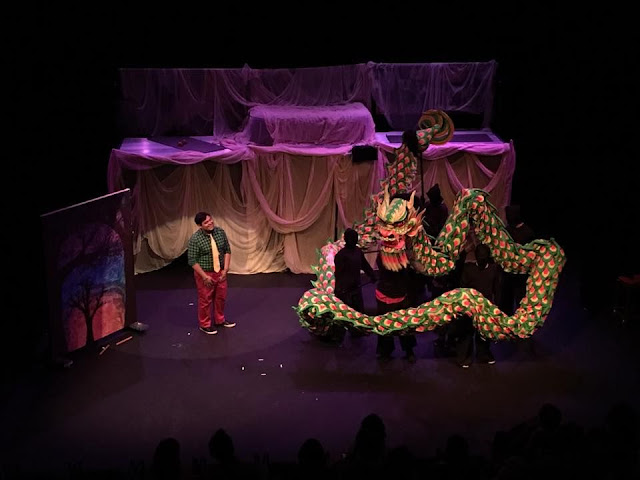
Another character that weaved all through alongside the protagonist was the metaphorical ‘Dragon’ a representative of the Chinese dragon dance. The director-protagonist Leng Wong made the most flawless traverse for the allegory of the dragon, which in the Chinese dance was used to ward off the evil but here was a personification of ‘fear’, the constant underlying fear of being ‘African-American’. And thus the dragon consistently converses with the lost Asian-American through the play to finally convince that it is the fear that makes up to the fight and the fight finally leads to live, to live is to hyphen! Jeffery Da’Shade Johnson being the filmmaker, brought about the definitive ‘filmy’ tearful ending along with the talented sole child actor of the play ZhaneD. Hall.

Credit her to her acting or her direction, Leng Wong deserves highest appreciation to bring feelings and experiences as personal, as sensitive and as controversial as these in such deep yet humorous way and stitched together in such brilliant fashion. The props (multiple layered podium, the moving scenic backgrounds, the paintings, the multimedia production et al) and the highly seasoned music ensemble with some complex rhythmic sequences in the flute, sitar, bass and doumbek never once felt like a forced inclusion or out of tune!


Spare a thought for the dragoners (balancing the dragon) though masked throughout worked through space and time in perfect synchrony!
‘Living on the hyphen’ is a must watch for all of us, for it mirrors every human at some point in life and The Kalaparva urges its readers to try help this group in such diligent pursuit! Gratitude immensely to Anuradha Naimpally who made this opportunity possible to give me my first professional media representation in Austin!


Related

The treasure of ‘Kala’ that she was and will be… true to her name!


Knowledge abound:Kalanidhi Narayanan
(Image courtesy: The Kalaparva)


The value association with loss of human life is most often made to time in the past. Some loses alongside creating a huge irrecoverable void, leave a community with timely responsibility to shoulder. Whilst the classical dance fraternity of India mourns the passing away of Smt. Kalanidhi Narayanan, unanimously regarded the doyen of ‘Abhinaya’ (much to herself very humbly denying such titles), they now stand to disseminate the art and spirit that Kalanidhi mami very liberally offered!
Amongst the existence of galaxy of senior stalwart disciples of mami who learnt under her direct tutelage, and who are currently coming to terms with this loss, I wondered who am I to even publish an obituary. Well, this comes as an ode to an idol whom many a youngster like me only idolized, never met in person yet whose art was so accessible and endearing that we ‘learnt to learn art’ and whose physical absence today is jerking.
She could be considered the metaphor to what ‘great teaching’ ought to be. In a field where unfortunately legacy is mistaken to be possession and where insecurity overpowers the sharing of knowledge, Kalanidhi mami has created gems through her large entourage of renowned students each revered as great gurus themselves, spread across the globe. She created a hence unprecedented and irreplaceable separate teaching system for abhinaya alone, where she could churn out a different mood and a varied expression each time she repeated a line of literature and more importantly magnanimously taught it all! It is this ceaseless and profound wealth turned into, so to say a monopolized genre called ‘abhinaya training’ that is now being flocked to, by the young professional world of dancers, who consider themselves fortunate on one hand and also take pride in learning under Kalanidhi mami’s students. What she has given will sure last for centuries to come – to learn and unlearn, but sadly now, nothing more would be churned….

Even on one side as she ensured a long oral continuum of a perplexing guru-shishya parampara, she contextualized herself in and with current techno-driven art practices with a colossal contribution of all times. The Kalakriya video series (DVD’s) for which Kalanidhi mami has lent her admirable performances and guided several audio-visual illustrated lectures have pillared understanding of abhinaya across cross section of dancers, to the extent to even facilitate and develop performing caliber and repertoire. In an era where every gesture of a dancer, every movement by a choreographer, every syllable by a singer, every click by a photographer and every piece of costume is ‘copyrighted’, Kalanidhi mami with all her stature, utmost willingly shared an art that became accessible to her only after life’s own crude ways. These videos would discernibly be archival material, but sadly now, we might have anybody so selfless in art…..
Quality preempts quantity in most walks of life and in art, more pertinently. It may be just a handful of books that came out of her pen, but each of them are frameworks of knowledge towards elementary, essential, extensive and exhaustive comprehension of abhinaya. Her books are as animated as her good self, for the reader could very easily create imaginative choreographies while in the reading stage of the book itself. Each narrative is so simple yet deep, so impactful yet colourful, making them opportune to both performance and academic study and to the amateur and the scholar at once. In this effort to share knowledge in its most pristine manner, despite it not being her genre (rather she would perform a javali or padam) shows the mirror towards a great visionary for the arts that she was, only now, sadly we cannot hold her next edition in hand…..

Padma Bhushan, Guru Smt. Kalanidhi Narayanan has left us an open treasure that has something for every soul….now sadly, the treasure will have no more additions……
May her soul rest in blissful peace…….


Related

Aromas of passion, pursuance and progression


Manjari:Mystique Fragrances by Divya Ravi
(Image courtesy: Amith Nag)


What makes a work of art repeatedly question the frontiers of creative instinct, find affirming answers and finally implement it within socio-cultural canons? Perhaps it is through conjecturing and possibly answering such questions that most art especially the classical traditions in India thrive and grow. Fortunately for classical Indian dance, amateurs to seniors to stalwarts equally experiment with extended and different boundaries of innovation, lending to the art form, a much sustainable character. This article primarily comes to document one such diligent effort, one such artistic impulse that succeeded in re-visiting artistic parameters through the artist’s interpretation.

‘Manjari’ travelled beyond frames of structure, space and time to present Bharatanatyam in its most affable form, whilst yet within narrative format and mythical story genre. Its mystique Fragrances dispersed ethereal content through a first protagonist – the flower. Divya Ravi, having conceived and conceptualized the theme, nimbly slipped into characterizing the second protagonist – the dance and the dancer!

Deciphering it to the essential etymology; blossoming of a bud, the commencing Alaripu was placed and paced convincingly within scope of the theme. While the gestural language was used to pronounce the evolution of a flower through the bud, movement analogies complimented it, sometimes within the pattern of the Alaripu and at times rather contrastingly. A little more simplicity in rhythmic pattern punctuating the item with silence would probably have rendered completeness.

Raising the tempo and mood, was a metaphoric construct of the happiness broached by a flower. A kriti as an ode to the ‘Ashoka’ delineated familiar legends and underpinning the vital role of visual medium in evoking basic human emotions. As a spectator, receiving such impact from the perspective of a joyous flower indeed sparked an almost ‘idle’ compassion towards nature, art and life on the whole. Dotted with interesting swara passages and smart choreography especially for the repetitive lines of ‘Pallavi’, the ‘flower’ prepared the right pedestal for the quintessential queen that came next….

‘Padma’ tantamount to the Varnam said it all – intensive contextual inquiry of untold epics, suitable juxtaposing to the classical language, unhurried execution with all the ‘vistaram’ on the part of the dancer and manifested performance by the ensemble, nattuvanar and vocalist in particular. The dancer should be lauded in her choice for appropriateness owing to the fact that she correlated the populist value of lotus for the common man with the prime fascination that classical dance has of the flower! Be it the refined description of ‘Pallavi- Prabhakara Priye’, spatially perfect connotation of evolution – bud to flower to fruit to animal to man, concise and clear animation of ‘Panchabhootas’ as a simile to denote the circumvent of nature, hued and just translation of insufficiencies of man (Kama, Krodha, Lobha, Moha, Mada and Matsarya) devoid of the slightest of exaggeration and a very smooth crafted second half, for once a Varnam retained its essence through length, depth and breadth!

At the risk of borrowing from one of my academic papers, I would reiterate the amazing quality of dance as an art form to mirror psychology within an individual that hardly makes itself apparent. As a dancer gets into the role-play of woman in relationship to ‘her man’, she most often traverses through unknown enigma yet is expected to expel powerful emotions. It seemed, that Divya categorically eschewed her persona for a thorough penetration into the character of an angered Satyabhama for not receiving the ‘Parijatha’. Thus, she vacillated from jealousy of not getting the flower, to anger of not having asked for any other flower to finally sarcasm towards Rukmini for her qualification to receive the flower in the most facile manner and perhaps most convincingly.

If one would justify that a performance should amplify in its very progress, then ‘Ketaki spelt a horizon of such boosting. In attempting to show lament on flower Ketaki’s self-destructive story, Divya infused herself in such silted amalgam that the line between character of a non-living entity (flower, if I may call so) and the dancer protagonist was almost invisible! Symbolic of one of man’s most destructive attribute – pride, the piece clearly stood in philosophical light lending for similar treatment into the last piece.

Though ending it in traditional style, the final item begged to differ from the Thillana in the way it interspersed and advocated through dance, three very profound scriptures. This final treatment of flower as engendering evolutionary fragrances, spreading happy fragrances and instilling spiritual fragrances could not but consummate the flower garland – Manjari!


If Manjari stood disparate for the technically sound accomplishment as a dance production, I would contest an equal testimony in Divya’s exquisite compering. But for her mellowed, confident and detailed narrative of the content along with a very forthcoming use of gestures during the process, the performance would not have forayed so well. The youngster must accept compliments in lacing such explanation very comfortably within the performative stretch and in her research of understanding her target audience. In a brief post performance talk with Sharan Subramaniam (credited to the script), he reminisced of experiments conducted with him as the subject for analyzing audience receptivity. If a certain concept failed to instigate the required response in an ‘almost uninitiated’ viewer as him, it was re-constructed. As art practitioners dabble with the ever diminishing audience for classical arts, it is this kind of sincere approach that comes productive. Divya tagged her audience in a memoir of classical art, Indian mythology and life’s simple virtues in a way that was most endearing amidst life of instant gratification that we live in. The exactly two hour presentation held its niche viewers until the last of the lights faded into its own fragrance.


That a young artiste attempted the so evidently claimed ‘risk’ might still be doing rounds, but Divya navigating through panache and supported by the most illustrious music ensemble with some soul-stirring music and by her teacher Dr. Soundarya Srivatsa puts all the fog to rest! (with sober fragrances, of course)
In my engaging conversations with Divya subsequently, it was indeed humbling that she inquired about any shortcomings and mulled over possible improvisations and perceptive changes. It is not uncommon that a creative endevour owing to its sheer nature scopes for very distinct constructions with every re-visit. Given this, though very enthusiastically hoping to indulge into such future revisions, the fact that Divya sought to look at ‘the other side’ amongst the wonderful aura of success and praise surrounding her was indeed exhibiting true character!


Analogous to titanic contribution of the music ensemble, the dancer gave a very subtle ‘working insight’ into the making. Nearly enjoying a monopoly over dance performance scenario, Sri Srivatsa, owing his true self, had extended warm support to the youngster and even pushed boundaries to meet her requirements specially in lyric composition. Most apt incorporation was the use of multiple languages – Kannada, Telugu and Tamil to suit the pieces and their themes. Further, while in the audience one could watch a deluge of emotions emitted by the orchestra itself! Sri Prasanna Kumar might have come thoroughly rehearsed but his rendition exuberated a child-like enthusiasm as if for a first attempt. Watching and listening to Sri Hari play to precision after a long time was utmost pleasing and Karthik’s animated expressions almost matched Divya’s on stage, rightly so – symbolizing the spirit of Bangalore – youngsters unselfishly supportive of each other.
I must end here, as I would even now be probably accused of overtly canvassing for the artiste and the production, but it diligently comes with my admiration for good work and admitted fervor for writing!


Related

A resilient instill of Psyche into Soma


Maanini - Expressions of Love


Amidst very pertinent cross cultural dialogues of bodies in traditional motion and their reactions to transition and change, it is reaffirming to examine classical Indian dance entrusting to and respond auspiciously to such ‘change’ than ever before! The statement, at the risk of being a bombastic one coming from an amateur, yet seeks a humble tone in the fact that it mirrors experience of watching classical dance in a global context in a continuous span. The most recent manifestation of this opinion comes from attending an animated choreographic marvel adopted into nine very diligent ‘bodies in motion’ of Bangalore.

Titled ‘Maanini – Expressions of Love’, Guru Kiran Subramanyam assimilated a rich body of tradition only to bind it into changed notions and formats, and the individual dancers from across different schools infused it through silted interpretations of their psyche and soma! Along the length and breadth of the presentation, a critical lens would allow for some amount of change for the sake of it as one characteristic of the choreography and difficult negotiation of some bodies, at some times to the changed presenting idiom.

‘Aarambh’, having been conceived and presented previously stood afresh in memory and for all its credit, it was epoch in the construct well before. Only this time, its dancers giving the multilayered effect and their liberal organization into a wholesome unit both personally and on the stage added a depth. The erstwhile ‘Alaripu’ stretched and circumscribed itself into emulating the entire theoretical and practical implication of ‘Angika abhinaya’. The dancers traversing lucidly between the gospel ‘Hastas, ‘Vinayogas’, ‘Stanakas’, ‘Bhedas’ and grouped ‘Mai adavaus’, ‘Mandi adavus’ pronounced heavy intention on the part of classical dance to give ‘change’ greater importance and impetus.

The pinnacle of the evening, as popularized much in advance, was ‘Maanini’ – the Purvi Kalyani Varnam metamorphosed into delineation of the ‘Ashtanayika avastha’ well into the strict structure and language of the Varnam. I reminisce Leela Venkataraman’s words here, from here book Tradition in Transition where she talks of change in classical dance as an inevitable part of tradition but cautions us on the importance of the direction that such change takes. Well, there was an important change here; rendering to the utmost essence of a literature that had already captured the various stages of a woman in love; the only gap that needed to be filled was a combination of an idea and its execution. Besides fringe supports in the form of stage, lighting and prop, handling of the ‘states of being’, intimacy on the part of dancers, histrionic expression suited to an ethereal effect succeeded in connecting basic human emotions in such natural connotations to the audience at large, a change that most often does not reach the desired effect.

Aranya Narain reveling as the ‘Swadeenapatika’ describing her man, Aparna Sastry in the jealous-sorrow ‘Vipralabha’ mode, Prathibha Ramaswamy doing the baleful ‘Khandita’, by alluring him off all ‘facilities’ he is used to, Matangi Prasan entrenched with a superlative bodily control in the ‘Virahotkantitha’, Rasika Kiran as the demur ‘Abhisarika’, Sneha Devanandan personifying the forever woman trait of adorning and waiting, ‘Vasakasajja’ especially with her very gracious walk back into the side screen, ‘Kalahantarita’ explored to fullest in Preethi Bharadwaj’s remorseful, suggestive yet powerful fall out were all so ingrained in their individualistic and powerful characterizations that the umpteen book definitions and colourful brush strokes of these nayikas came alive with a perfect harmony of the soul and body! The molding of Shivaranjini Harish and Shruti Gopal into the narrative thread did best to augment their innate strengths. With the exhaustion of the these Nayikas during the first half, even as one wondered the role of the latter half of the Varnam, the dancers playing the sakhis lifting up the main protoganist’s mood in the ‘Swaras’ was a very syntactic and welcome change. However questions like should the ‘Nayika avasthas’ have spilled to the second half too? Or was there a scare of monotony in the format? Was this a change to voluntarily change perceptions? Lingered on….

Thillana was a reflection of authority and ownership on the niche of ‘Laya’ carefully nurtured by Kiran Subramanayam in a very creditable tone. While it served well for all the prior description of cumulating mathematics of rhythm and geometry of space and patterns into classical dance, a naïve watcher like me was left baffled with the tension between excessive movement, similar movement and differenced movement on stage. Well, change has different dimensions and settles in slowly. Music ensemble stood apart characterized by only a steep ascent and not visibly calling for a changed outlook.
Maanini represented ‘change’ in an engrossed discussion with dance and its dancers, ‘changed’ choreographic scripting and ‘changing’ audience perceptions.
PS: I owe the use of words ‘Psyche’ and ‘Soma’ to mean soul and body respectively to a conversation with my professor who used them.


Related

With ‘Love’ and ‘Rhythm’: Maanini


Maanini
(Image courtesy: Rasika Academy of Performing Arts)


“Dance is the hidden language of the soul”. As much as this quote of Martha Graham illuminates the pinnacle of dancing sensibilities, a team of nine dancers of Bangalore under the mentorship of Sri Kiran Subramanyam attempt to decipher such meaning and reach out to their souls through Maanini.

A multilayered textural presentation of basic grammar of Bharatanatyam, Maanini is a revelation of both the rhythmic and expressional elements in a formatted group choreography. When Bangalore is busy bargaining with a gloomy weather for Diwali celebrations, I meet this team drenched in sweat after a grueling practice session, who were kind enough to give an animated preview.

All of them voice in unison that trained to the professional brim in different schools, adapting to a particular technique, though consumed time, challenged them thoroughly. During the three month tenure of instruction, it was the experience of learning and weaving intricate rhythmic patterns with core calculations and maths into their presentation that was a great import in the dancers’ career. Courtesy that Sri Kiran’s forte lies in this genre of choreography, the dancers recognize and acknowledge the opportune moment of such previlige and thorough work. Apart from imbibing from each other’s strengths and style of dancing, it is a seamless harmony that they vouch for as a strong foundation, hoping sincerely that it would show off on stage.

Talking of his delineation towards the concept of Ashtanayika, Sri Kiran explicates of woman psychology being interpreted through these states of ‘being’ and how it was an intense activity to analyse emotional natures of each of the dancers and give them roles that would best suit or bring out hitherto unattempted performances. Converging such multiple expressions of love towards a single stretch of a varnam was according to him a united juxtaposition of his vision, sketching of a situation whilst allowing freedom over responsibility and suggestive ability on the part of the dancer, to which the dancers readily agree asserting it to be a journey of self-introspection and a mirror of their day-to-day emotions.

Being the innate perfectionist, Sri Kiran has ensued the best of musicians, technical and administrative arrangements towards the production and his team of dancers are more than awaiting to paint coloured flavours on the stage! Premiering this in culture conscious Bangalore,they feel, is only humbling what with the abundance of talent and cultivated audience for classical arts. While the team gears up for performance and enjoy sweet nothings of a very pleasant bond built, Kalaparva wishes them the best and invites audience to come and watch Maanini which,premiers on Friday, 20th November, 2015 at ADA Rangamandira, JC Road, Bengaluru at 6 PM. Featured artistes are Shivaranjini Harish, Prathibha Ramaswamy, Preethi Bharadwaj, Sneha Devanandan, Aranya Narain, Matangi Prasan, Aparna Shastry, Shruti Gopal and Rasika Kiran. Concept and Choreography by Sri Kiran Subramanyam, Administration and Costumes by Smt. Sandhya Kiran and Co-ordination by Ramya Janakiraman.


Related